


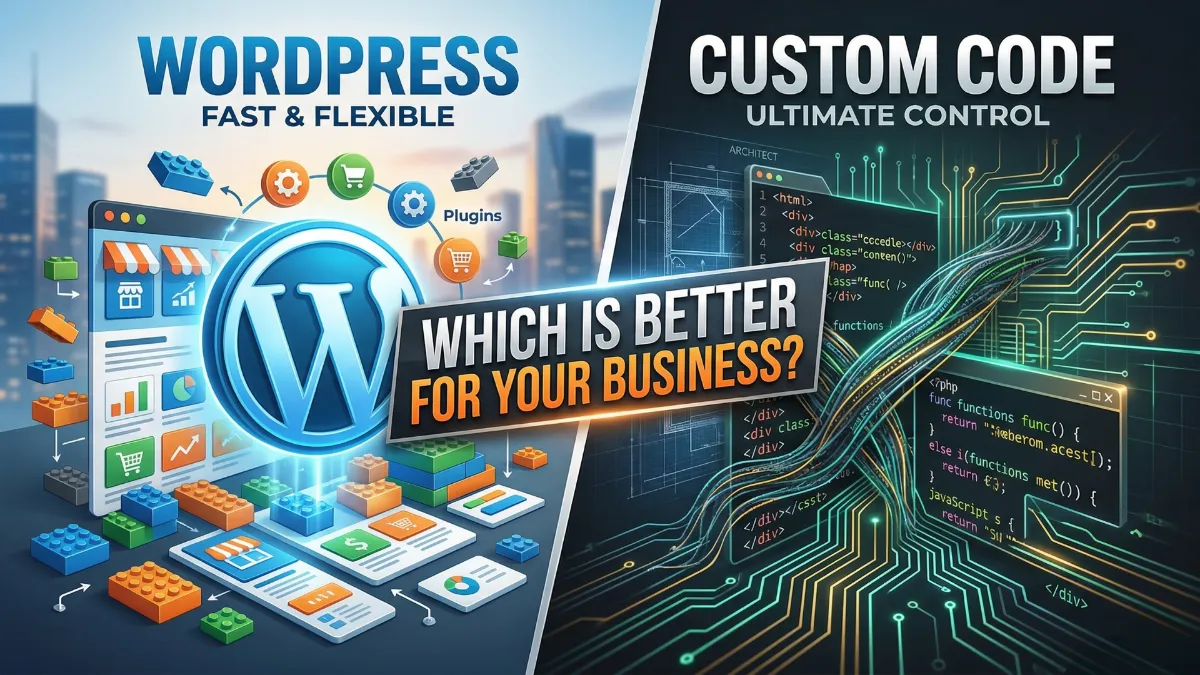
WordPress vs Custom Code: Which Is Better for Your Business?
If you are planning to build a website for your business, one of the first and most important decisions you will face is choosing the right technology. Should you go with WordPress the world’s most popular content management system or invest in a fully custom-coded website built from scratch?
This is a question we hear almost every day at Lexiata, where we have built over 1,500 websites for businesses across Sri Lanka and internationally. The answer is not always straightforward because it depends on your specific business goals, budget, timeline, and long-term plans.
In this comprehensive guide, we break down every aspect of the WordPress vs custom code debate — from cost and development time to performance, SEO, security, and scalability so you can make a confident, informed decision for your business.
What Is WordPress?
WordPress is an open-source content management system (CMS) that powers approximately 43% of all websites on the internet. Originally launched in 2003 as a blogging platform, WordPress has evolved into a full-featured website builder capable of running everything from simple business websites to complex e-commerce stores, learning management systems, and membership platforms.
WordPress uses a combination of themes (for design), plugins (for functionality), and a visual editor (like Elementor, Gutenberg, or Divi) that allows website owners to manage their content without writing any code.
Key Characteristics of WordPress
WordPress operates on PHP and MySQL, runs on virtually any web hosting environment, and benefits from a massive global community of developers, designers, and contributors. With over 60,000 free plugins and thousands of premium themes available, WordPress offers unmatched flexibility for businesses of all sizes.
Popular websites built on WordPress include TechCrunch, The New Yorker, BBC America, Sony Music, and countless small and medium businesses worldwide.
What Is a Custom-Coded Website?
A custom-coded website is built entirely from scratch using programming languages like HTML, CSS, JavaScript, PHP, Python, React, Node.js, or other technologies. Every line of code is written specifically for your project, with no pre-built themes, templates, or CMS frameworks involved.
Custom development gives you complete control over every aspect of your website from the database structure and server-side logic to the front-end design and user experience. There are no limitations imposed by a CMS framework, which means your website can be engineered to do exactly what your business needs.
Key Characteristics of Custom Code
Custom websites are typically built by experienced development teams using modern frameworks and architectures. They require more time and investment upfront but can deliver superior performance and unique functionality that may not be achievable with off-the-shelf CMS solutions.
Examples of custom-built platforms include Facebook, Twitter, Netflix, and Airbnb though these represent the extreme end of custom development.
WordPress vs Custom Code: A Detailed Comparison
Let us examine the most important factors that should influence your decision.
1. Cost and Budget
WordPress: Building a professional business website on WordPress typically costs between Rs 39,900 and Rs 199,900 in Sri Lanka (approximately $130 to $650 USD). This includes design, development, hosting, domain registration, SSL certificate, and basic SEO setup. E-commerce websites with WooCommerce integration usually fall in the Rs 64,900 to Rs 300,000 range.
Premium themes cost between $30 and $100, and essential plugins range from free to $200 per year. Annual maintenance, hosting, and domain renewal typically cost Rs 15,000 to Rs 40,000.
Custom Code: A custom-coded website for a similar scope starts at Rs 300,000 and can easily exceed Rs 1,000,000 or more depending on complexity. Even a basic five-page custom website requires significantly more development hours because every component navigation, forms, responsive design, database connections must be coded from scratch.
Ongoing maintenance costs are also higher because you need a developer for even minor changes.
Verdict: WordPress wins decisively on cost for most small and medium businesses. Custom code is justified only when your project has unique technical requirements that WordPress genuinely cannot handle.
2. Development Time
WordPress: A standard corporate website can be designed and launched in 7 to 14 working days. E-commerce websites typically take 14 to 30 days. This speed is possible because WordPress provides a ready-made foundation user authentication, content management, media handling, database structure that does not need to be built from scratch.
Custom Code: The same corporate website would take 4 to 12 weeks to develop custom. E-commerce platforms can take 3 to 6 months or longer. Every feature that WordPress provides out of the box — content editing, user management, SEO tools, image optimization must be manually developed and tested.
Verdict: WordPress delivers significantly faster time-to-market. If you need your website live quickly, WordPress is the clear choice.
3. Design Flexibility
WordPress: With modern page builders like Elementor Pro, WordPress offers virtually unlimited design flexibility. You can create completely custom layouts, animations, interactive elements, and unique visual experiences without writing code. The myth that WordPress websites all look the same is outdated in the hands of a skilled designer, WordPress can produce websites that are visually indistinguishable from custom-coded ones.
However, WordPress themes do impose some structural conventions. While these can be overridden, doing so sometimes requires custom CSS or PHP modifications.
Custom Code: Custom development offers absolute design freedom with zero constraints. Every pixel, animation, and interaction can be precisely controlled. If your project requires highly experimental or unconventional interfaces that push the boundaries of web design, custom code gives you that unrestricted canvas.
Verdict: For 95% of business websites, WordPress with Elementor Pro provides more than enough design flexibility. Custom code is only necessary for highly experimental or application-like interfaces.
4. Performance and Speed
WordPress: WordPress performance depends heavily on how the website is built. A poorly configured WordPress site with excessive plugins, unoptimized images, and cheap hosting can be slow. However, a properly optimized WordPress website — with clean code, caching, image compression, a CDN like Cloudflare, and quality hosting routinely achieves 90+ scores on Google PageSpeed Insights.
At Lexiata, every WordPress website we build is optimized for Core Web Vitals, with typical load times under 3 seconds on mobile devices.
Custom Code: A well-built custom website has the potential for superior performance because it contains only the code it needs no unused theme files, no plugin overhead, no CMS framework weight. Custom sites can achieve near-perfect PageSpeed scores with minimal effort.
However, poor custom coding can result in websites that are actually slower than a well-optimized WordPress site. Performance ultimately depends on the developer’s skill, not the platform itself.
Verdict: Slight edge to custom code in theory, but properly optimized WordPress performs excellently for business websites. The performance difference is negligible for most use cases.
5. SEO (Search Engine Optimization)
WordPress: WordPress is inherently SEO-friendly. With plugins like Rank Math or Yoast SEO, you get comprehensive control over title tags, meta descriptions, schema markup, XML sitemaps, canonical URLs, Open Graph tags, breadcrumbs, and more all without writing code.
WordPress also makes it easy to publish blog content, create internal linking structures, optimize images with alt tags, and implement structured data. The platform’s mature ecosystem means that SEO best practices are well-documented and widely supported.
Custom Code: SEO on a custom website requires manual implementation of every optimization element. There is no plugin to automatically generate sitemaps, manage meta tags, or add schema markup. Every SEO feature must be coded, tested, and maintained by your development team.
This is not necessarily a disadvantage custom implementations can be highly optimized. But it requires significantly more effort, expertise, and ongoing maintenance compared to WordPress.
Verdict: WordPress wins for SEO due to its extensive plugin ecosystem and ease of optimization. Custom code can match WordPress SEO capabilities, but at a much higher cost and effort.
6. Security
WordPress: WordPress is frequently targeted by hackers because of its popularity powering 43% of the web makes it an attractive target. Common vulnerabilities include outdated plugins, weak passwords, nulled themes, and misconfigured hosting environments.
However, a properly secured WordPress website is extremely robust. Security best practices include keeping WordPress core, themes, and plugins updated; using strong passwords and two-factor authentication; implementing a web application firewall (like Cloudflare WAF); disabling XML-RPC and file editing; adding security headers; and monitoring for malware.
At Lexiata, we implement comprehensive security hardening on every website we build, including custom security configurations without relying on heavy security plugins.
Custom Code: Custom websites have a smaller attack surface because hackers cannot exploit known CMS vulnerabilities. There are no plugins with publicly disclosed security flaws, and the codebase is not publicly available for analysis.
However, custom code is not immune to security issues. SQL injection, cross-site scripting (XSS), cross-site request forgery (CSRF), and other vulnerabilities must be specifically addressed during development. A single coding mistake can create a serious vulnerability.
Verdict: Custom code has a theoretical security advantage due to obscurity, but WordPress with proper hardening is more than secure enough for business websites. The key factor is implementation quality, not the platform.
7. Content Management and Updates
WordPress: This is where WordPress truly excels. The WordPress admin panel allows non-technical users to add pages, edit content, upload images, manage products, publish blog posts, and update menus without any coding knowledge.
Visual editors like Elementor make it possible to create and modify complex page layouts through drag-and-drop. This means your team can manage the website independently after launch, reducing ongoing dependency on developers.
Custom Code: Content management on a custom website typically requires developer intervention for anything beyond basic text changes. Unless you invest in building a custom admin panel (which adds significant development cost and time), making content updates requires someone with coding knowledge.
Some custom projects address this by building a headless CMS architecture (using tools like Strapi or Contentful), but this adds complexity and cost.
Verdict: WordPress wins decisively. The ability for non-technical team members to manage website content independently is one of WordPress’s greatest strengths.
8. Scalability
WordPress: WordPress can scale to handle millions of monthly visitors when properly configured. Websites like TechCrunch and The New Yorker demonstrate that WordPress can handle enterprise-level traffic. However, scaling WordPress requires investment in quality hosting infrastructure, caching layers, database optimization, and CDN implementation.
For most Sri Lankan businesses, WordPress handles typical traffic volumes effortlessly with standard hosting configurations.
Custom Code: Custom websites can be architected for virtually unlimited scalability from the ground up. You have complete control over database design, caching strategies, server architecture, and code optimization. If your project anticipates massive traffic or complex data processing requirements, custom architecture provides the most flexibility.
Verdict: For most businesses, WordPress scales more than adequately. Custom code is preferred only for projects with extreme performance or data processing requirements think social networks, real-time platforms, or applications serving millions of concurrent users.
9. Maintenance and Long-Term Support
WordPress: WordPress requires regular maintenance including core updates (released approximately every 3 months), plugin updates, theme updates, security patches, database optimization, and backup management. While this sounds demanding, most maintenance tasks can be automated or handled through affordable monthly maintenance plans.
The WordPress ecosystem ensures that finding developers for ongoing support is straightforward and cost-effective.
Custom Code: Maintaining a custom codebase requires developers who understand the specific architecture and coding patterns used in your project. If the original development team becomes unavailable, onboarding new developers can be time-consuming and expensive because they need to learn the entire codebase from scratch.
There are no automatic updates, no community-maintained security patches, and no plugin ecosystem to add new features quickly.
Verdict: WordPress is significantly easier and more affordable to maintain long-term. The availability of WordPress developers worldwide means you are never locked into a single provider.
10. E-Commerce Capabilities
WordPress: WooCommerce, the leading WordPress e-commerce plugin, powers over 28% of all online stores globally. It provides comprehensive features including product management, inventory tracking, payment gateway integration (PayHere, Stripe, PayPal), shipping calculations, tax handling, order management, and customer accounts.
The WooCommerce ecosystem includes hundreds of extensions for advanced functionality like subscriptions, bookings, multi-vendor marketplaces (Dokan), and product customization.
Custom Code: Custom e-commerce development allows you to build exactly the shopping experience you envision, with no compromises. However, implementing features that WooCommerce provides out of the box — cart functionality, checkout flow, payment processing, order emails, inventory management — requires extensive development time.
Verdict: WordPress with WooCommerce is the smart choice for most e-commerce businesses. Custom development is justified only for highly unique shopping experiences or platforms with complex business logic that WooCommerce cannot accommodate.
When Should You Choose WordPress?
WordPress is the right choice for your business if:
You need a professional website within a reasonable budget. Your project involves a corporate website, blog, portfolio, e-commerce store, or service-based business website. You want the ability to manage and update content without technical knowledge. SEO and content marketing are important to your digital strategy. You need to launch quickly and start generating results. You want access to a large ecosystem of plugins and integrations. You prefer affordable, widely available ongoing support and maintenance. Your business is in Sri Lanka or any market where cost-effectiveness matters.
When Should You Choose Custom Code?
Custom development is the right choice if:
Your project requires unique functionality that no existing CMS or plugin can provide. You are building a web application, SaaS platform, social network, or real-time system. Your project has extreme performance requirements with millions of concurrent users. You have a substantial development budget (Rs 500,000+ or $2,000+ USD). Your timeline allows for extended development periods (3 to 6 months or more). You have access to a reliable development team for ongoing maintenance and updates.
The Hybrid Approach: Best of Both Worlds
At Lexiata, we often recommend a hybrid approach that combines the ease of WordPress with custom development where needed. This includes building on WordPress and Elementor for content management and design flexibility while developing custom WordPress plugins for unique business logic and functionality.
This approach gives you the content management ease of WordPress, the design flexibility of Elementor, the SEO power of Rank Math, and the unique functionality of custom code all within a single, manageable platform.
For example, our B2B Marketplace platform uses WordPress as the foundation with a fully custom plugin handling supplier management, product catalogs, and business-to-business transactions. Our LMS platform combines WordPress with custom plugins for tutor management, Zoom integration, and credit-based booking systems.
Real Cost Comparison for Sri Lankan Businesses
To give you a practical perspective, here is a real cost comparison based on typical projects we handle at Lexiata:
For a corporate website with five to seven pages, WordPress development costs Rs 39,900 to Rs 64,900 while custom development would cost Rs 300,000 to Rs 500,000. The WordPress project takes 7 to 14 days while the custom project takes 6 to 10 weeks.
For an e-commerce store with product listings and payments, WordPress with WooCommerce costs Rs 64,900 to Rs 199,900 while custom development ranges from Rs 500,000 to Rs 1,500,000. WordPress takes 14 to 30 days compared to 3 to 6 months for custom.
For a custom web application like an LMS or marketplace, WordPress with custom plugins costs Rs 200,000 to Rs 500,000 while fully custom development costs Rs 800,000 to Rs 2,000,000 or more.
Our Recommendation
For the vast majority of businesses whether you are in Sri Lanka, the UK, Australia, UAE, or anywhere else WordPress is the smarter choice. It delivers professional results at a fraction of the cost, launches faster, is easier to maintain, and provides excellent SEO and performance when properly optimized.
Custom code should be reserved for genuinely unique technical requirements that WordPress cannot address and in our experience of building over 1,500 websites, those situations are rare.
At Lexiata, we specialize in building high-performance WordPress websites that look custom-built, perform exceptionally, and rank well on Google. If you are unsure which approach is right for your project, contact us for a free consultation. We will honestly assess your requirements and recommend the solution that delivers the best value for your specific situation.
Frequently Asked Questions
Is WordPress good enough for a professional business website? Yes. WordPress powers websites for companies of all sizes, from local startups to global corporations. With proper design and optimization, a WordPress website is indistinguishable from a custom-coded one in terms of visual quality and performance.
Can WordPress handle high traffic? Yes. WordPress can handle millions of monthly visitors when configured with quality hosting, caching, CDN, and database optimization. Major news and media websites run on WordPress without issues.
Is custom code more secure than WordPress? Not necessarily. Security depends on implementation quality, not the platform. A properly hardened WordPress website with regular updates, strong passwords, and a web application firewall is extremely secure.
Can I switch from WordPress to custom code later? Yes, but it involves rebuilding the website from scratch. The content can be migrated, but the design and functionality need to be redeveloped. This is why choosing the right platform from the start is important.
How much does website maintenance cost? WordPress maintenance typically costs Rs 5,000 to Rs 15,000 per month in Sri Lanka, covering updates, backups, security monitoring, and minor content changes. Custom website maintenance is significantly more expensive due to the specialized knowledge required.